
Filter
Disponible

LANGUAGE : Anglais
KEYWORDS : Islamic Fiqh | jurisprudence | Islamic law | fatwa | contemporary fiqh | Islamic legal opinions | OIC Fiqh Council | Islamic finance | halal and haram | Islamic ethics | collective ijtihad | modern issues in Islam | sharia rulings | medical ethics in Islam | Muslim scholars | Islamic economics | fiqh academy
PUBLISHER : MUSLIM WORLD LEAGUE
PAGES-NUMBER : 276
YEAR : 2002
ABSTRACT : The Islamic Fiqh Council Journal is an academic journal published by the Islamic Fiqh Council, an international body of prominent scholars and jurists dedicated to providing legal rulings (fatwas) based on Islamic jurisprudence (fiqh). The journal covers a wide range of topics, including traditional Islamic law, contemporary legal issues, and modern challenges faced by the Muslim community. It publishes research articles, legal opinions, fatwas, and theological discussions on issues such as Islamic finance, bioethics, women's rights, technology, and interfaith relations. The journal serves as a crucial resource for scholars, students, and practitioners of Islamic law, offering insights into how Islamic principles can be applied to modern-day issues while maintaining fidelity to traditional jurisprudential thought.
Disponible
LANGUAGE : Anglais
KEYWORDS : Islamic Fiqh | jurisprudence | Islamic law | fatwa | contemporary fiqh | Islamic legal opinions | OIC Fiqh Council | Islamic finance | halal and haram | Islamic ethics | collective ijtihad | modern issues in Islam | sharia rulings | medical ethics in Islam | Muslim scholars | Islamic economics | fiqh academy
PUBLISHER : MUSLIM WORLD LEAGUE
PAGES-NUMBER : 553
YEAR : 2002
ABSTRACT : The Islamic Fiqh Council Journal is an academic publication produced by the Islamic Fiqh Academy, an international body consisting of scholars and jurists from various Islamic schools of thought (madhahib). The journal addresses contemporary legal and ethical issues within the framework of Islamic law (sharia), providing fatwas (legal opinions) and scholarly discussions on a wide range of topics, such as finance, bioethics, social issues, and other modern challenges faced by the Muslim community. The decisions and fatwas issued in the journal are used by religious authorities and researchers to guide Islamic practice in the modern world. The journal serves as a critical resource for understanding how Islamic legal principles can be applied in contemporary contexts, making it invaluable for scholars and practitioners of Islamic law.
Disponible
LANGUAGE : Français
KEYWORDS : Islamic Fiqh | jurisprudence | Islamic law | fatwa | contemporary fiqh | Islamic legal opinions | OIC Fiqh Council | Islamic finance | halal and haram | Islamic ethics | collective ijtihad | modern issues in Islam | sharia rulings | medical ethics in Islam | Muslim scholars | Islamic economics | fiqh academy
PUBLISHER : MUSLIM WORLD LEAGUE
PAGES-NUMBER : 553
YEAR : 2002
Disponible
LANGUAGE : Anglais
KEYWORDS : Islamic Fiqh | jurisprudence | Islamic law | fatwa | contemporary fiqh | Islamic legal opinions | OIC Fiqh Council | Islamic finance | halal and haram | Islamic ethics | collective ijtihad | modern issues in Islam | sharia rulings | medical ethics in Islam | Muslim scholars | Islamic economics | fiqh academy
PUBLISHER : MUSLIM WORLD LEAGUE
PAGES-NUMBER : 285
YEAR : 2002
ABSTRACT : The Islamic Fiqh Council Journal is an academic journal published by the Islamic Fiqh Council, an international body of prominent scholars and jurists dedicated to providing legal rulings (fatwas) based on Islamic jurisprudence (fiqh). The journal covers a wide range of topics, including traditional Islamic law, contemporary legal issues, and modern challenges faced by the Muslim community. It publishes research articles, legal opinions, fatwas, and theological discussions on issues such as Islamic finance, bioethics, women's rights, technology, and interfaith relations. The journal serves as a crucial resource for scholars, students, and practitioners of Islamic law, offering insights into how Islamic principles can be applied to modern-day issues while maintaining fidelity to traditional jurisprudential thought.
Disponible
LANGUAGE : Anglais
KEYWORDS : Islamic Fiqh | jurisprudence | Islamic law | fatwa | contemporary fiqh | Islamic legal opinions | OIC Fiqh Council | Islamic finance | halal and haram | Islamic ethics | collective ijtihad | modern issues in Islam | sharia rulings | medical ethics in Islam | Muslim scholars | Islamic economics | fiqh academy
PUBLISHER : MUSLIM WORLD LEAGUE
PAGES-NUMBER : 315
YEAR : 2002
ABSTRACT : The Islamic Fiqh Council Journal is an academic journal published by the Islamic Fiqh Council, an international body of prominent scholars and jurists dedicated to providing legal rulings (fatwas) based on Islamic jurisprudence (fiqh). The journal covers a wide range of topics, including traditional Islamic law, contemporary legal issues, and modern challenges faced by the Muslim community. It publishes research articles, legal opinions, fatwas, and theological discussions on issues such as Islamic finance, bioethics, women's rights, technology, and interfaith relations. The journal serves as a crucial resource for scholars, students, and practitioners of Islamic law, offering insights into how Islamic principles can be applied to modern-day issues while maintaining fidelity to traditional jurisprudential thought.
Disponible
LANGUAGE : Anglais
KEYWORDS : Islamic Fiqh | jurisprudence | Islamic law | fatwa | contemporary fiqh | Islamic legal opinions | OIC Fiqh Council | Islamic finance | halal and haram | Islamic ethics | collective ijtihad | modern issues in Islam | sharia rulings | medical ethics in Islam | Muslim scholars | Islamic economics | fiqh academy
PUBLISHER : MUSLIM WORLD LEAGUE
PAGES-NUMBER : 219
YEAR : 2002
ABSTRACT : The Islamic Fiqh Council Journal is an academic journal published by the Islamic Fiqh Council, an international body of prominent scholars and jurists dedicated to providing legal rulings (fatwas) based on Islamic jurisprudence (fiqh). The journal covers a wide range of topics, including traditional Islamic law, contemporary legal issues, and modern challenges faced by the Muslim community. It publishes research articles, legal opinions, fatwas, and theological discussions on issues such as Islamic finance, bioethics, women's rights, technology, and interfaith relations. The journal serves as a crucial resource for scholars, students, and practitioners of Islamic law, offering insights into how Islamic principles can be applied to modern-day issues while maintaining fidelity to traditional jurisprudential thought.
Disponible
AUTHOR : C.G WEERAMANTER
LANGUAGE : Français
KEYWORDS : Islamic jurisprudence | Fiqh | Sharia law | Comparative jurisprudence | Legal theory | Usul al-fiqh | Islamic law | Legal schools | Contemporary perspectives
PUBLISHER : VISHVZ LEKHA
YEAR : 1999
ABSTRACT : "Islamic Jurisprudence: A Perspective" by C.G. Weeramantry explores the foundations, evolution, and application of Islamic law (fiqh) within both historical and contemporary contexts. Weeramantry examines the core sources of Islamic jurisprudence, including the Qur'an, Sunnah, ijma (consensus), and qiyas (analogical reasoning), and analyzes how these principles interact with modern legal systems. The book also delves into the human rights aspects of Islamic law, addressing the compatibility between Islamic principles and universal human rights. Furthermore, it discusses the role of Islamic jurisprudence in global legal discourse, highlighting its significance across diverse legal traditions and its potential for coexistence with modern legal frameworks. By examining the different schools of Islamic thought and their impact, the book offers a comprehensive view of Islamic law's adaptability and relevance in the modern world.
Disponible
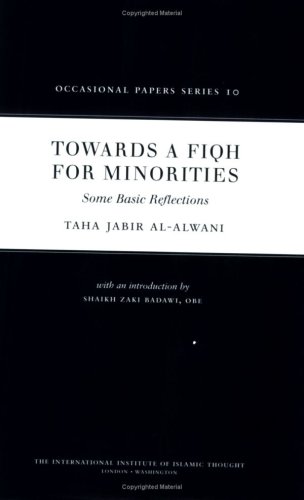
AUTHOR : taha jabir al-alwani | Zaynab alawiye, ashur a.shamis
ISBN : 1-56564-400-X
LANGUAGE : Anglais
KEYWORDS : Fiqh | Islamic Law | Minorities | Islamic Jurisprudence | Fiqh for Minorities | Muslim Minorities | Islamic Ethics | Social Justice in Islam | Minority Rights | Islamic Diversity | Islam in the West | Islamic Theology | Shariah and Minorities
PUBLISHER : the international institute of islamic thought
PAGES-NUMBER : 50
YEAR : 2003
Disponible
AUTHOR : Imran Ahsan Khan Nyazee
ISBN : 969-408-156-4
LANGUAGE : Anglais
KEYWORDS : Theories of Islamic Law | Usul al‑Fiqh | Ijtihād
PUBLISHER : Zafar Ishaq Ansari
PAGES-NUMBER : 344
YEAR : 1945
ABSTRACT : This book provides a critical analysis of the diverse methodologies within Islamic jurisprudence, challenging the notion of a single, uniform theory of Islamic law. Nyazee identifies three major legal theories: the theory of general principles, the theory of strict interpretation and analogy (qiyas), and the theory of the objectives of Sharia (maqasid al-sharia). He explores the dynamic tension between the apparent rigidity of Islamic legal texts and the practical flexibility of their application, proposing the concept of "cooperating spheres"—one fixed and text-based, the other flexible and state-regulated. This nuanced approach offers a deeper understanding of how Islamic law adapts to contemporary needs while remaining rooted in its foundational texts, making the book essential for scholars and practitioners of Islamic law.
Disponible
AUTHOR : MAHK MID
LANGUAGE : Anglais
KEYWORDS : Islam | Encyclopedia | History | Theology | Muslim Civilization | Islamic Culture | Fiqh | Science | Sociology | Philosophy.
PUBLISHER : LEIDEN
PAGES-NUMBER : 787
YEAR : 1991
Disponible
AUTHOR : ABDULLAH ALWI HAJI HASSAN
LANGUAGE : Anglais
KEYWORDS : Islamic commercial law | early Islamic contracts | Islamic sales | fiqh al-mu'amalat | Islamic jurisprudence | Shariah and trade | early Islamic economy | business contracts in Islam | Islamic contract law | Islamic legal history
PUBLISHER : ISLAMIC RESEARCH INSTITUT
PAGES-NUMBER : 265
YEAR : 2026
ABSTRACT : This scholarly work by Abdullah Alwi Haji Hassan offers a foundational study of the principles and rules governing commercial transactions during the early period of Islamic history. The book meticulously analyzes the legal framework of sales (buyū') and contracts (ʻuqūd), tracing their evolution from pre-Islamic practices to their establishment based on the Qur'an and Sunnah. It comprehensively covers essential legal concepts, including trade ethics, market management, partnership types, voidable contracts, and restrictions such as the prohibitions of usury (Ribā) and excessive speculation (Gharar). Ultimately, the book serves to provide the fundamental legal material necessary for understanding the underlying principles of modern Islamic economics and finance.
Disponible
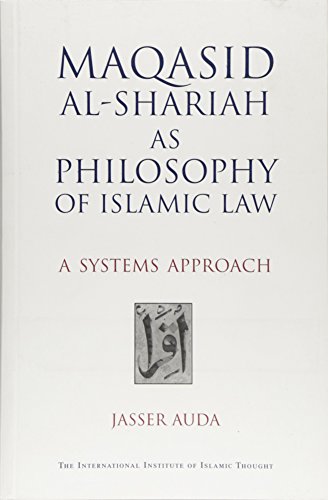
AUTHOR : Jasser Auda
ISBN : 978-1-56564-424-3
LANGUAGE : Anglais
KEYWORDS : Maqasid al-Shariah | Islamic law | Islamic jurisprudence | usul al-fiqh | legal theory | Jasser Auda | objectives of Shariah | systems thinking | philosophy of Islamic law | Islamic legal reform
PUBLISHER : The international institute if islamic thought
PAGES-NUMBER : 348
YEAR : 2026
ABSTRACT : "Maqasid al-Shariah as Philosophy of Islamic Law: A Systems Approach" by Jasser Auda, published by The International Institute of Islamic Thought, explores the concept of Maqasid al-Shariah (the objectives or purposes of Islamic law) through a systems approach. Auda redefines the traditional understanding of Maqasid by presenting it as a comprehensive, integrated framework aimed at achieving justice, human dignity, and sustainable development within society. The book connects Islamic jurisprudence with contemporary social needs and challenges, arguing that the objectives of Shariah go beyond legal rulings to encompass broader goals of social welfare, freedom, and human rights. It offers a modern perspective on how Islamic law can address current issues while remaining faithful to its core principles.
Disponible
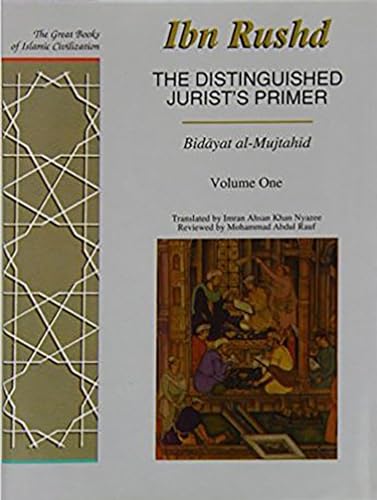
AUTHOR : ibn rushd | imran ahsan khan nyazee | mohammad adbul rauf
ISBN : 1-873938-13-6
LANGUAGE : Anglais
KEYWORDS : Bidayat al-Mujtahid | Islamic law | Fiqh | Ibn Rushd | Comparative jurisprudence | Sharia | Madhhab | Legal theory | Usul al-fiqh | Maliki law | Sunni schools of law | Legal reasoning in Islam
PUBLISHER : centre for muslim contribution to civilization
PAGES-NUMBER : 609
YEAR : 1994
ABSTRACT : In *Bidayat al-Mujtahid*, Ibn Rushd discusses and compares the major Islamic jurisprudential schools of thought, focusing on the differences between the four main schools: Hanafi, Maliki, Shafi'i, and Hanbali, in their interpretations of complex legal issues. He argues that these differences are not due to misunderstandings but rather stem from differing views on the interpretation of Islamic texts. Ibn Rushd emphasizes that ijtihad (independent legal reasoning) is a right for every qualified scholar, and that there should be no blind adherence to one particular school over others. He highlights that the diversity of opinions in Islamic jurisprudence reflects the richness of Islamic thought and the various methods of deriving legal rulings from the sources.
Disponible
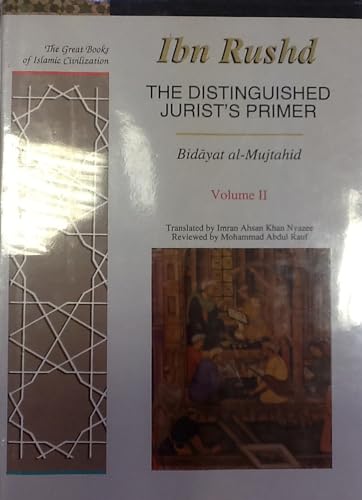
AUTHOR : ibn rushd | imran ahsan khan nyazee | mohammad adbul rauf
ISBN : 1-873938-93-4
LANGUAGE : Anglais
KEYWORDS : Bidayat al-Mujtahid | Islamic law | Fiqh | Ibn Rushd | Comparative jurisprudence | Sharia | Madhhab | Legal theory | Usul al-fiqh | Maliki law | Sunni schools of law | Legal reasoning in Islam
PUBLISHER : centre for muslim contribution to civilization
PAGES-NUMBER : 619
YEAR : 1996
ABSTRACT : In *Bidayat al-Mujtahid*, Ibn Rushd discusses and compares the major Islamic jurisprudential schools of thought, focusing on the differences between the four main schools: Hanafi, Maliki, Shafi'i, and Hanbali, in their interpretations of complex legal issues. He argues that these differences are not due to misunderstandings but rather stem from differing views on the interpretation of Islamic texts. Ibn Rushd emphasizes that ijtihad (independent legal reasoning) is a right for every qualified scholar, and that there should be no blind adherence to one particular school over others. He highlights that the diversity of opinions in Islamic jurisprudence reflects the richness of Islamic thought and the various methods of deriving legal rulings from the sources.
Disponible
AUTHOR : abdullah alwi haji hassan
ISBN : 969-408-136-X
LANGUAGE : Anglais
KEYWORDS : Islamic law | commercial law | sales contracts | early Islamic jurisprudence | fiqh | trade regulations | classical Islamic law | contract validity | Islamic legal theory | business ethics | Sharia | transactions | Islamic contract types | muamalat | historical Islamic commerce
PUBLISHER : islamic research institute international islamic university
PAGES-NUMBER : 266
YEAR : 1986
ABSTRACT : This study deals with the early development of Islamic contractual and commercial law. The Introduction presents the Arabian commercial background during the time prior to the advent of Islam to show the historical sequence and the economic phenomena, especially commercial, of pre-Islamic Arabia, which gave rise to the development of Islamic commercial law. In this part, explanations are also made on the basis of the Qur'änic injunctions on commerce and trade and the commercial life of Muslims. Theoretical issues concerning the concept of sale and the scope of this study are also discussed. CHAPTER I deals with moral and ethics in trade. This chapter includes the encouragements, discouragements and prohibitions in commercial transactions. CHAPTER II gives the management and modes of the market and its classifications and voidable contracts. CHAPTER III risk (al-gharar) in sale and permissible sales are discussed. It comprises (of) an inquiry into risk in sale, including the definition of al-gharar (risk in sale), the rules to elude al-gharar and the gharar transactions. This chapter also examines the permissible sales, i.e. sale by advance (al-salam) and sale of fresh dates by estimation (bay' al-"aräyä). CHAPTER IV covers the restrictions on sales. It is restricted to a discussion of sale of excess water and -xiother communal properties, exchange of animals for animals on credit, exchange of precious metals and foodstuffs on credit, sale by an agent and the capital specified when paying and sale by a written document (al-bay' bi al-sakk). In CHAPTER V, partnership in business transactions and pre-emption (al-shuf'a) are dealt with. It analyses al-mudäraba (dormant partnership) and its quasi-contracts, al-sharika (mercantile partnership) and al-shuf'a (preemption). CHAPTER VI studies loans, deposit (al-wadl'a) and interdiction (al-hajr), in particular al-gard (loan of fungible objects for consumption), al-'äriyya (loan of non-fungible commodities), al-wadi'a (deposit), al-hajr (interdiction) and their early legal developments. In CHAPTER VII, the early legal development of suretyship (al-kaff la) and pledge or security (al-rahn) are discussed and examined. CHAPTER VIII discusses the contract of hiring (al-ijära) and pay in return for work (al-ju'ä1a), focusing on the embryonic evolution of their legal expansions. Finally, CHAPTER IX covers juridical settlement of disputes, amicable settlement (al-sulk) and extinction of an obligation which includes wäla (assignment, of debts and sale by bill of exchange (bay' bi al-suftaja). The conclusion summarizes and resolves the various discussions in each chapter of the thesis.